


Société Générale: record profit and falling shares. Is the market punishing the bank or France?
We discussed Société Générale live on my stream with the Discord and IG communities. We went through the press release, revenue, debt, margins and capital, and came across four figures that didn’t make sense at first glance:
- gross margin of 86% versus net margin of 12%
- debt that has grown significantly over the past year
- 2025 profit that jumped by more than 40%
- operating expenses that, according to the data, shot up from 2.4 to 43.8 billion EUR
We left them as open questions on the stream. In this article, I follow up on them: I tracked down answers to each in primary sources and brought together everything we tackled in bits and pieces on the stream into a single investment thesis.
And that thesis rests on one contradiction. In July, the bank announced record quarterly profit, raised its profitability target and launched an extraordinary share buyback of 1.5 billion EUR, which we also came across on the stream. In September, it presented a plan through 2029 that analysts received positively. Nevertheless, the shares have lost roughly a fifth of their value since the results. So the question at the heart of this analysis is: Is the market punishing Société Générale, or France, where it is based? And is today’s price an overreaction or the beginning of a problem?
Analysis summary in 60 seconds
- Company: France’s third-largest banking group. It earns money through three divisions: French retail banking with online bank BoursoBank, investment banking, and international retail banking with car leasing company Ayvens, which also includes Komerční banka.
- Current results: Record net profit of 1.79 billion EUR for Q2 2026 (+23% year over year) and ROTE of 12.2% (return on tangible equity, or how much the bank earns on capital excluding goodwill and intangible assets). Costs fell by 4%, and the bank raised its 2026 ROTE target to 11%.
- Why the shares are falling: Not because of the results, but because of France. The yield on the 10-year French government bond hit its highest level since 2002 at the beginning of October, while its spread over the German bond reached its highest level since the 2011 euro crisis. The market fears more expensive financing, taxes on large companies and a recession.
- What’s priced in: The shares trade at 0.87 times tangible book value (P/TBV, the share price relative to equity per share excluding goodwill). That implies a sustainable ROTE of 10-11%. Yet the bank earned 12% in H1 2026 and is promising 13-14% in 2029.
- Main risk: French retail growth depends on net interest margin, not volumes. Both loans and deposits are declining. If the margin effect runs out and a French crisis hits, ROTE will fall below 10%.
- Scenarios (end of 2028): Bull case 102 EUR, base case 84 EUR, bear case 56 EUR, catastrophic case 33 EUR. Weighted average 76 EUR, excluding dividends.
- What to watch: French budget votes on 20 and 27 October, Q3 results on 29 October 2026, the OAT-Bund spread, French retail banking net interest income, and annual loan-loss costs relative to loan volume.
- Key question: Can the bank keep raising ROTE even if France remains in trouble? If so, today’s discount for France is too large. If not, it’s a value trap.
Analysis contents
1. Company overview
2. Business model
3. MOAT
4. Competition
5. Four questions from the stream
6. Financial results
7. Balance sheet and capital
8. Capital efficiency: ROTE, RONE and cost of capital
9. Macro: France, bonds and interest rates
10. Credit quality and stress test
11. Controversies and risks
12. Valuation
13. Scenarios
14. Catalysts and what to watch
15. Conclusion
16. My personal view
1. Company overview
Société Générale $GLE.PA was founded in Paris in 1864 and is now one of France’s three major banking groups, alongside BNP Paribas and Crédit Agricole. According to its own figures, it has around 110,000 employees and 27 million clients in 58 countries. It has been led by Slawomir Krupa since 2023; in February 2026, the board extended his term by another four years, starting in 2027. For Czech readers, it’s important to note that Komerční banka is part of the group: in the figures, you’ll find it in the international retail division under the Europe and Czech Republic lines.
The bank earns money like any large universal bank. It lends money at a higher rate than it borrows it, charges fees for accounts, wealth management, insurance and advice, and trades in financial markets for large clients. In 2025, it had revenue of 27.3 billion EUR and record net profit of 6.0 billion EUR. In H1 2026, revenue was 14.2 billion EUR and net profit was 3.49 billion EUR.
The most important fact: Société Générale is a bank that has turned itself around. In 2023, it earned just 4.2% on tangible equity (ROTE); by 2025, that was 10.2%, and in H1 2026 it was 12.0%. The shares responded: they rose roughly 160% in 2025. The key question is whether the turnaround is sustainable and whether France, which the bank cannot leave, can derail it.
2. Business model
On the stream, we explained the business model using a paragraph at the end of the press release, where the company describes its three divisions. It’s the most accurate description available, because it’s regulated information, not marketing. I added a table of net profit by division from the press release appendix.
2.1 Three divisions and who earns what
1. French retail, private banking and insurance: SG’s branch network, a private bank with 145 billion EUR in assets under management, an insurer with 167 billion EUR in life insurance, and online bank BoursoBank. In H1 2026, it earned 1.30 billion EUR in net profit with RONE of 14.2% (RONE is the return on the capital the group allocates to a division; I explain it in chapter 8).
2. Investment banking (Global Banking and Investor Solutions): Trading in equities and derivatives, where SG is among the world’s leaders; trading in bonds, currencies and credit (FICC); project and corporate finance; advisory services; and securities services. In H1 2026, it earned 1.64 billion EUR with RONE of 19.1%.
3. Mobility, international retail and financial services: Universal banks in the Czech Republic, Romania and Africa, car leasing company Ayvens, and consumer lending. In H1 2026, it earned 0.73 billion EUR with RONE of 13.5%. Komerční banka is growing faster here than the rest of the group: loans in the Czech Republic were up 8.0% and deposits up 10.2% year over year in Q2 2026 at constant exchange rates.
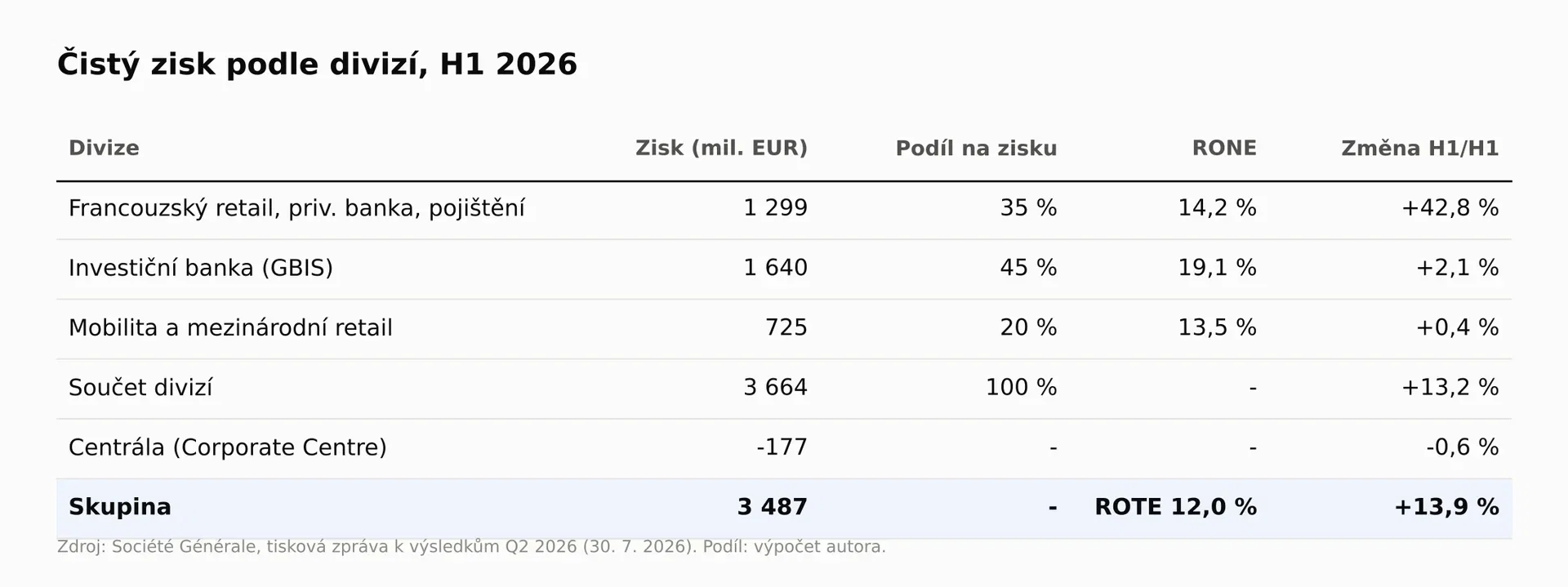
Investment banking accounts for 45% of divisional profit, French retail for 35%, and the international division for 20%. Yet the market trades the stock primarily as a bet on France, even though the largest share of profit comes from a division that operates worldwide and has the highest returns. The difference between the sum of the divisions (3.66 billion EUR) and group profit (3.49 billion EUR) comes from headquarters, which ties up capital and operates at a loss. Investment banking profit is more volatile, and in a French crisis the market would treat it just as harshly as retail.
2.2 Revenue quality
I assessed revenue quality as we did on the stream: stable revenue versus volatile revenue. In H1 2026, French retail generated 2.38 billion EUR in net interest income and 2.24 billion EUR in fees, international retail generated 1.75 billion EUR, and financing and advisory generated 1.86 billion EUR. These revenues change slowly. On the other hand, Global Markets generated 3.25 billion EUR, or 23% of group revenue. Within that, two different trends are emerging: equities were up 5.5% in H1 2026, while FICC was down 15.0%. We don’t need to worry about customer concentration at this bank.
Roughly three quarters of revenue is “banking” and a quarter is “markets.” That’s a normal mix for a European universal bank. The risk isn’t that trading is large, but that its weaker segment is concentrated in Europe and interest rates, where SG has been losing ground for three consecutive quarters.
2.3 BoursoBank: unit economics
BoursoBank is the best example of unit economics in the entire group. At the end of Q2 2026, it had 9.1 million clients; more than 280,000 new ones joined during the quarter, and its churn rate (the share of clients who leave in a year) remains below 4%. Deposits rose 9% year over year to 49 billion EUR, while loans rose 8% to 17.8 billion EUR. In Q2 2026, it earned 84 million EUR in net profit with RONE of 60.7%, and its full-year 2026 target is over 300 million EUR. The plan through 2029 calls for more than 14 million clients. If I multiply quarterly profit by four and divide it by the number of clients, that works out to 37 EUR in profit per client per year and 9,200 EUR in managed assets per client (my simplified calculation).
The model works much like a subscription: the bank pays once to acquire a client and then earns a margin from them for years, while losing fewer than 4% of clients annually. The counterargument is scale: even 300 million EUR is 5% of annual group profit, so BoursoBank alone can’t support the investment thesis. And some of its growth comes at the expense of SG’s traditional branch network, where deposits are falling.
3. MOAT
Strong: Equity derivatives and structured products. The company says it has a unique global position in equity derivatives, and the figures support that: equity revenue exceeded 1 billion EUR in Q2 2026 and reached 3.63 billion EUR in 2025. Expertise in pricing and hedging complex derivatives takes decades to build, and clients (insurers, private banks, distributors of structured products) don’t switch providers easily. Cheap funding is another strong advantage: the group has 626 billion EUR in client deposits, and French retail lends only 87% of what it has in deposits.
Moderate: BoursoBank (RONE of 60.7%, churn below 4%) is strong, but it faces competition in French online banking, and its advantage is mainly scale and brand, not technology that no one else can replicate. The second moderate advantage is international retail in the Czech Republic and Romania: strong local positions and growing loans, but also local taxes. Romania, for example, doubled its bank tax retroactively from July 2025.
Weak or debatable: The French branch network. The division’s cost/income ratio improved to 55.5% in Q2 2026, but mainly thanks to cuts, while SG network deposits fell 3% year over year and loans fell 2%. That’s more a share of a shared market than an advantage. SG itself says the environment is unfavorable for its portfolio, which is concentrated in Europe and interest rates. Ayvens is also debatable: profit from used-car sales normalized from 1,455 EUR per vehicle in 2024 to 330 EUR in Q2 2026.
SG’s true moat lies in derivatives and deposit-funded financing. The rest are good but replicable positions. Its derivatives advantage could be weakened mainly by capital regulation for market risk or a major operational error like the one the bank experienced in 2008. The advantage of cheap deposits is weakened by digitalization, since clients can move their money with a single click.
4. Competition
I compare SG with BNP Paribas $BNP.PA, Crédit Agricole SA $ACA.PA and Deutsche Bank $DBK.DE. On the stream, we warned about an issue with the reporting period: Deutsche Bank mainly reports ROTE for half-years, while SG also reports it quarterly. That’s why the table compares H1 2026 across the board.
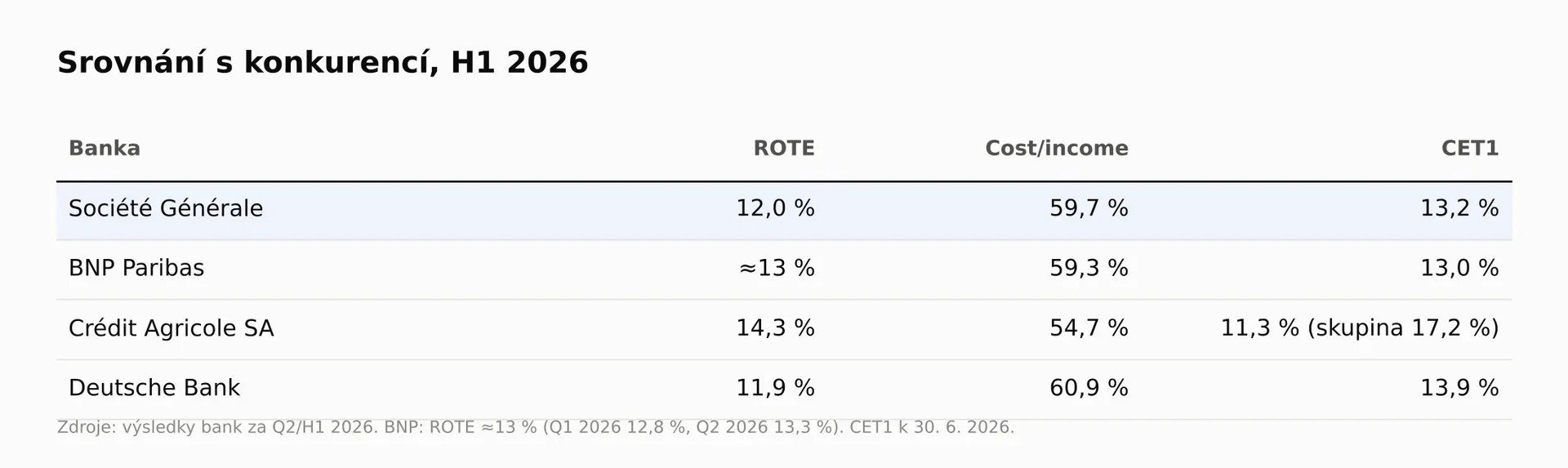
The result: In H1 2026, SG earned 12.0% on capital, BNP Paribas 13%, Crédit Agricole SA 14.3% and Deutsche Bank 11.9%. In cost efficiency, SG’s cost/income ratio of 59.7% is practically in line with BNP’s 59.3% and better than Deutsche Bank’s 60.9%; Crédit Agricole SA is best at 54.7%. In terms of capital (CET1, high-quality equity relative to risk-weighted assets), SG is at 13.2%, around the group average. Crédit Agricole SA’s CET1 of 11.3% is not directly comparable, because it is backed by a cooperative group with CET1 of 17.2%.
As recently as 2023, SG ranked last by a wide margin on every metric (cost/income of 73.8%, ROTE of 4.2%). Today, it differs from BNP by only a few percentage points. If that holds, the valuation gap should narrow too. I haven’t verified competitors’ valuations as of the same date, though, so I won’t quantify them here.
5. Four questions from the stream
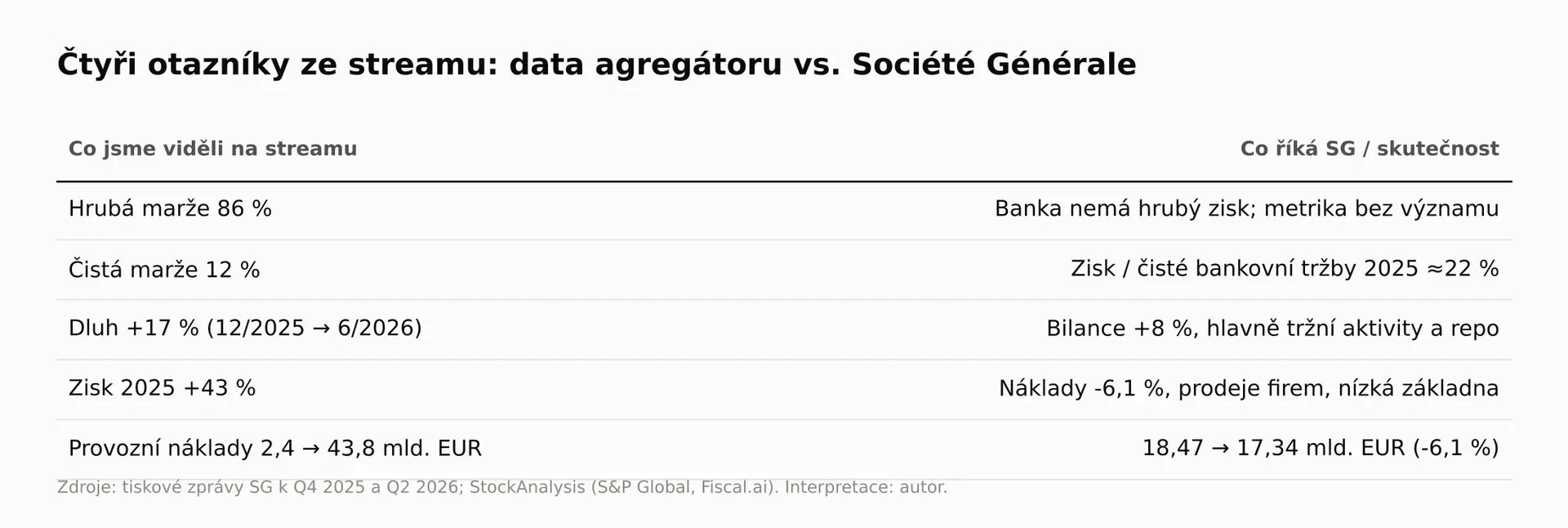
On the stream, we opened the data from a common aggregator, and four figures didn’t make sense. I found answers to all of them in SG’s press release, and they all point to the same lesson: data services are built for industrial companies, and banks have to be shoehorned into their templates. The table shows side by side what we saw and what the bank says.
5.1 Gross margin of 86% and net margin of 12%
Where I found the answer: In the Group consolidated results table at the beginning of the press release. The bank has no cost of goods sold, and therefore no gross profit in the industrial sense. Its revenue (net banking income, NBI) is itself a difference: interest received minus interest paid, plus fees and trading results. The aggregator calculates gross margin according to its own methodology, producing a figure with no economic meaning. The 12% net margin comes from dividing 2025 profit of 6.0 billion EUR by revenue of 50 billion EUR, roughly double net banking revenue. Most likely, that figure represents gross interest received and other income before deducting interest paid to depositors and creditors.
Relative to net banking revenue, SG’s net margin for 2025 was 22%. A third source, StockAnalysis, shows 27.3%, because it calculates profit including minority interests and revenue after deducting loan losses. Three sources, three margins, and all are “correct” according to their own definitions. That’s why I don’t track margins for a bank. I track the cost/income ratio (operating expenses as a share of revenue; 59.7% in H1 2026) and ROTE.
5.2 Debt that grew significantly
Where I found the answer: In the balance sheet in the press release appendix and in the chapter on financial structure. According to StockAnalysis, total debt rose from 302.9 billion EUR at the end of 2025 to 354.3 billion EUR as of 30 June 2026, up 17% in half a year. But for a bank, debt is a raw material, not investment financing. The group’s balance sheet grew from 1,547 to 1,673 billion EUR (+8%), with the biggest increases on both sides coming from market activities: financial assets at fair value rose from 576 to 663 billion EUR, liabilities at fair value from 398 to 458 billion EUR, and liabilities to banks from 104 to 122 billion EUR. This is typically repos (short-term loans secured by securities) and servicing investment bank clients. Issued bonds rose only from 151 to 158 billion EUR, and the parent bank had completed 96% of its 2026 issuance plan by the end of July.
Growth in “debt” isn’t a warning sign on its own. But there is a real signal: the leverage ratio fell from 4.5% at the end of 2025 to 4.3% as of 30 June 2026, against a requirement of 3.6%. The buffer is still 70 basis points, but the balance sheet is growing faster than capital. That’s the figure worth monitoring instead of debt.
5.3 2025 profit jumped 43%
Where I found the answer: In the Q4 2025 press release and the breakdown of profit by division. Net profit rose from 4.20 to 6.00 billion EUR. It wasn’t a miracle, but a recovery from a low base: in 2023, the bank earned just 2.49 billion EUR because short-term interest rate hedges hurt French retail and integrating LeasePlan cost money.
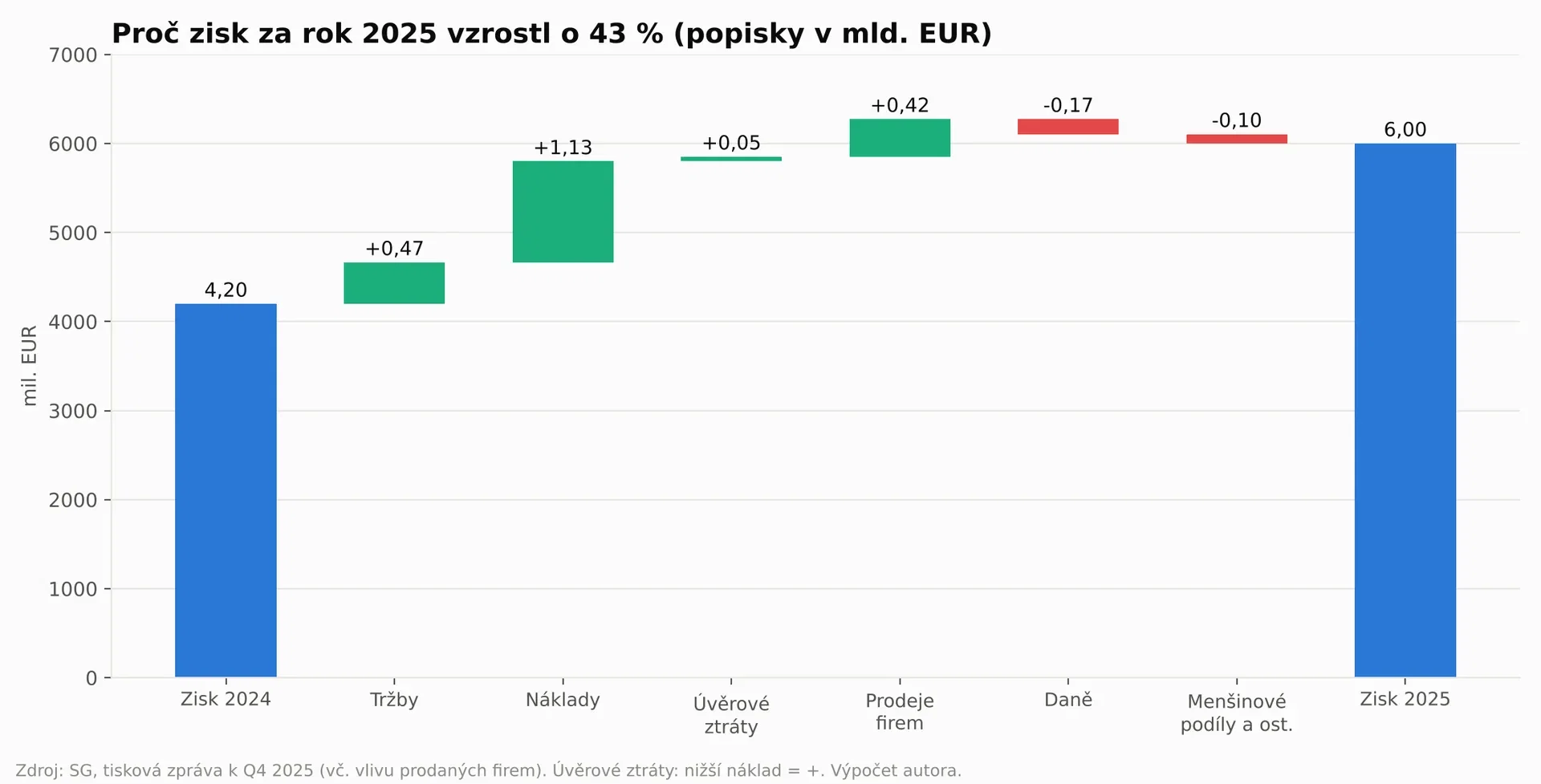
Of the 1.80 billion EUR increase, 1.60 billion EUR came from gross operating profit: operating expenses fell by 1.13 billion EUR (-6.1%) and revenue rose by 0.47 billion EUR. Another 0.42 billion EUR came from gains on business disposals (+345 million EUR in 2025 versus -77 million EUR in 2024), mainly from the sale of the Swiss private bank, SG Kleinwort Hambros and African subsidiaries. Loan losses fell by 0.05 billion EUR. Higher taxes, on the other hand, took away 0.17 billion EUR and minority interests 0.10 billion EUR. By division, French retail grew from 1.01 to 1.82 billion EUR (+80%), and the headquarters loss narrowed from -0.91 to -0.22 billion EUR.
Part of the growth is one-off. Without gains from business disposals, 2025 ROTE would have been 9.6% instead of 10.2%. More important is a footnote in the press release: French retail net interest income rose 15.3% in 2025 excluding the impact of disposals, but only 3.1% excluding the effect of short-term hedges. Most of the growth was therefore the tail end of an old problem, not new strength. I return to this in chapter 11.
5.4 Operating expenses from 2.4 to 43.8 billion EUR
Where I found the answer: In the same results table. Operating expenses were 18.47 billion EUR in 2024 and 17.34 billion EUR in 2025, a 6.1% decline. Both figures we saw on the stream are mapping errors. I don’t know exactly which source the data came from, so this is my estimate: in 2024, the data service captured only the “other operating expenses” line, and in 2025 it added interest expenses or insurance expenses to operating costs. StockAnalysis also shows that this happens: for SG, it reports “total non-interest expenses” of 1.34 billion EUR for the last 12 months and 16.98 billion EUR for 2025. Same company, nearly the same period, and a twelvefold difference just because the wages and overhead line is missing from one column.
The lesson from all four questions: For a bank, always open the press release and the Group consolidated results table. An aggregator is good for a quick overview, not for analysis. And when a number looks absurd, first look for a definition error, not a corporate scandal.
6. Financial results
A bank’s income statement is ordered differently from an industrial company’s: revenue, operating expenses, gross operating profit, cost of risk, operating profit and net profit. I don’t calculate free cash flow for a bank, because money is its raw material and the cash flow statement says nothing about the bank’s health. I track whether profit creates capital.
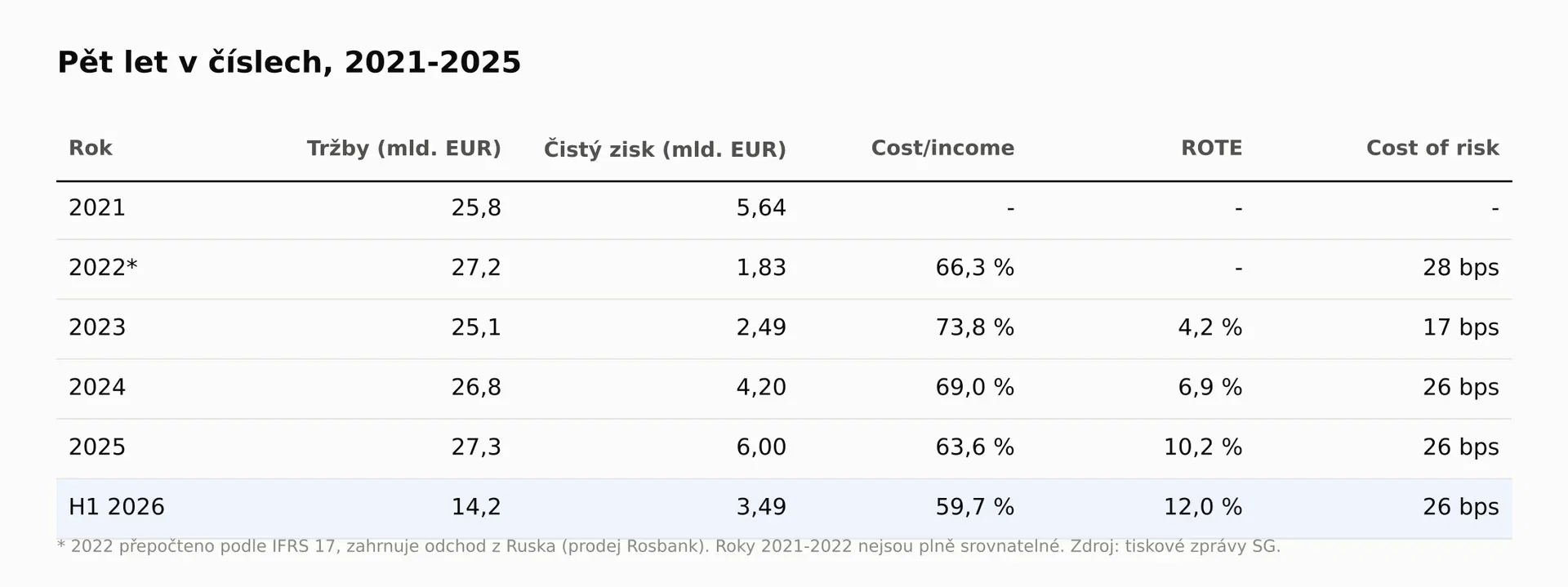
Revenue barely grew over five years: from 25.8 billion EUR in 2021 to 27.3 billion EUR in 2025, or 1.4% annually. Net profit, meanwhile, went through a full cycle: 5.64 billion EUR in 2021, a decline in 2022 due to the exit from Russia (the sale of Rosbank), a bottom in 2023 (2.49 billion EUR, ROTE of 4.2%), and a turnaround in 2024 and 2025. Profit was therefore driven not by revenue growth, but by costs: cost/income fell from 73.8% in 2023 to 63.6% in 2025 and 59.7% in H1 2026. The 2021 and 2022 figures are not fully comparable with today because of a new accounting standard for insurers and the exit from Russia.
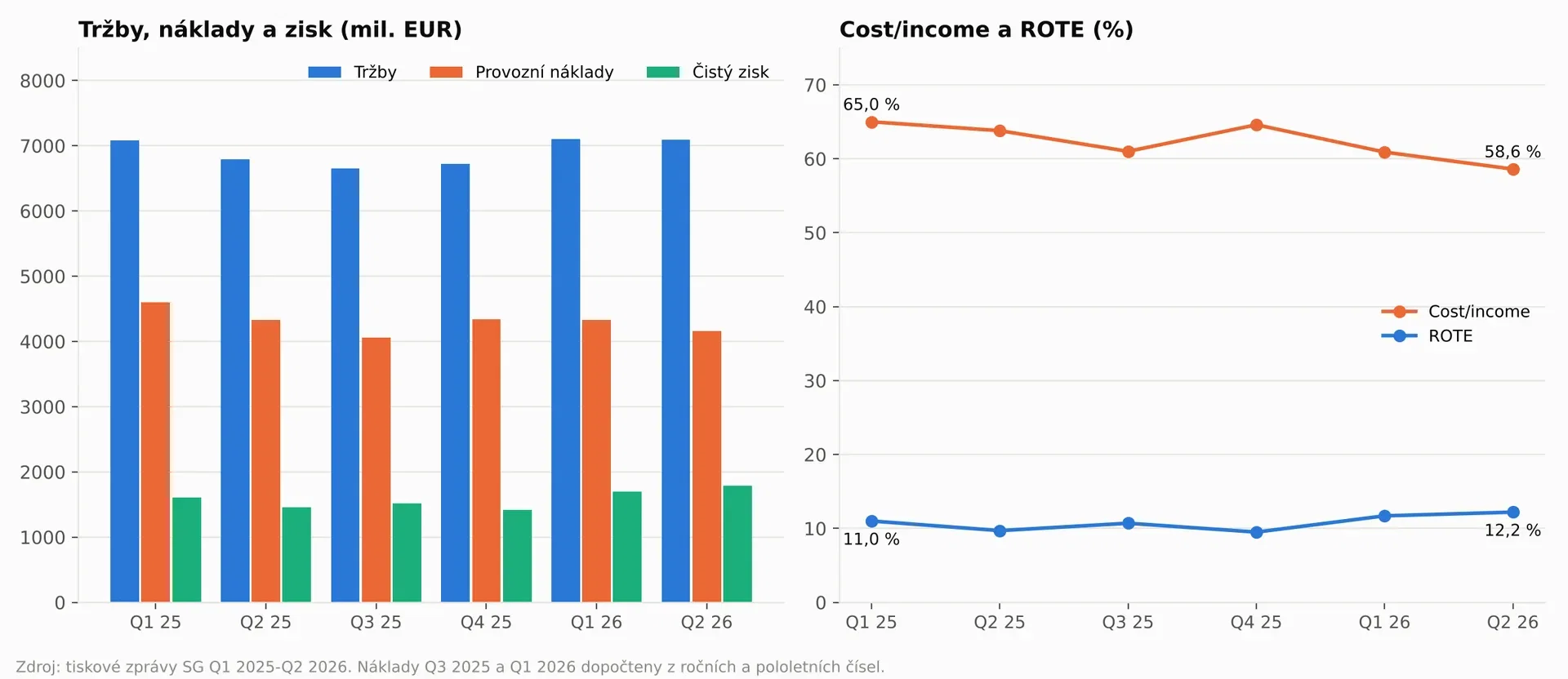
Over the past six quarters, cost/income fell from 65.0% (Q1 2025) to 58.6% (Q2 2026), and ROTE rose from 11.0% to 12.2%. In Q2 2026, revenue grew by 4.5% and costs fell by 4.1%, which is exactly the operating leverage we showed on the stream: gross operating profit was up 19.5% year over year. Note the seasonality: banking fees are paid once a year in the first quarter, so Q1 looks artificially weak and the other quarters stronger.
Operating leverage in reverse: On the stream, we asked what would happen if revenue fell by 10% and costs stayed the same. Doubling H1 2026 gives revenue of 28.4 billion EUR, costs of 17.0 billion EUR and gross operating profit of 11.4 billion EUR. A 10% drop in revenue would reduce gross operating profit by 25%. It’s my simplified estimate, but it shows that cost cutting works both ways.
Recurring “one-offs”: The Main exceptional items table includes an employee share program: 127 million EUR in Q2 2026, 101 million EUR in Q2 2025. The company classifies it as an exceptional item with no impact on distributable profit because it’s a non-cash expense. But it appears every year, so I treat it as a regular expense. Transformation costs, on the other hand, are genuinely disappearing: 613 million EUR in 2024, 262 million EUR in 2025 and 34 million EUR in H1 2026, which is a very positive sign.
7. Balance sheet and capital
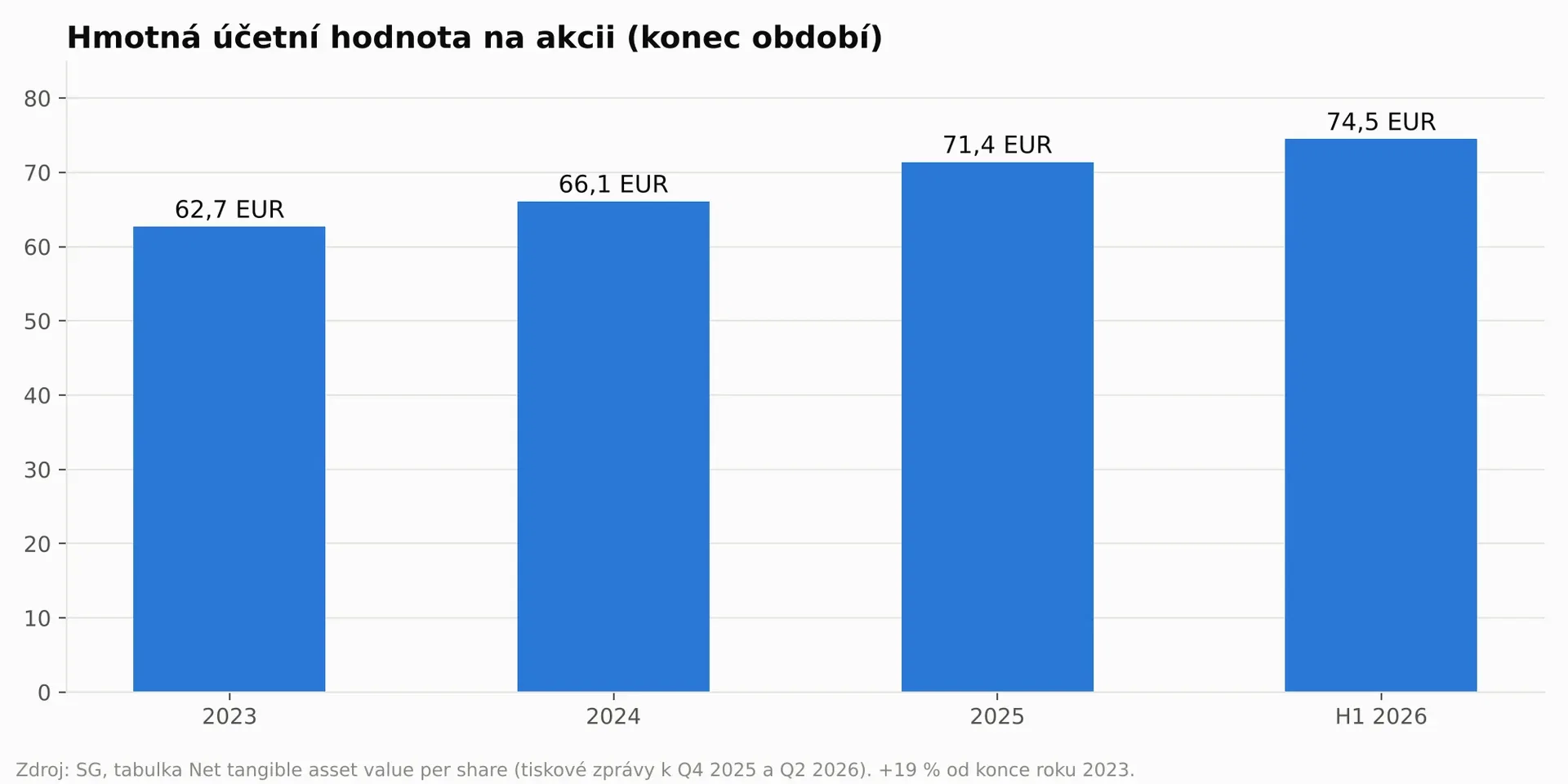
The most important figure on a bank’s balance sheet is CET1, its highest-quality equity relative to risk-weighted assets. SG reports it after deducting the planned buyback and dividend provision, which is why CET1 fell from 13.5% at the end of 2025 to 13.2% as of 30 June 2026 despite growing profit. The regulator’s requirement is 10.26%, leaving a buffer of 290 basis points.
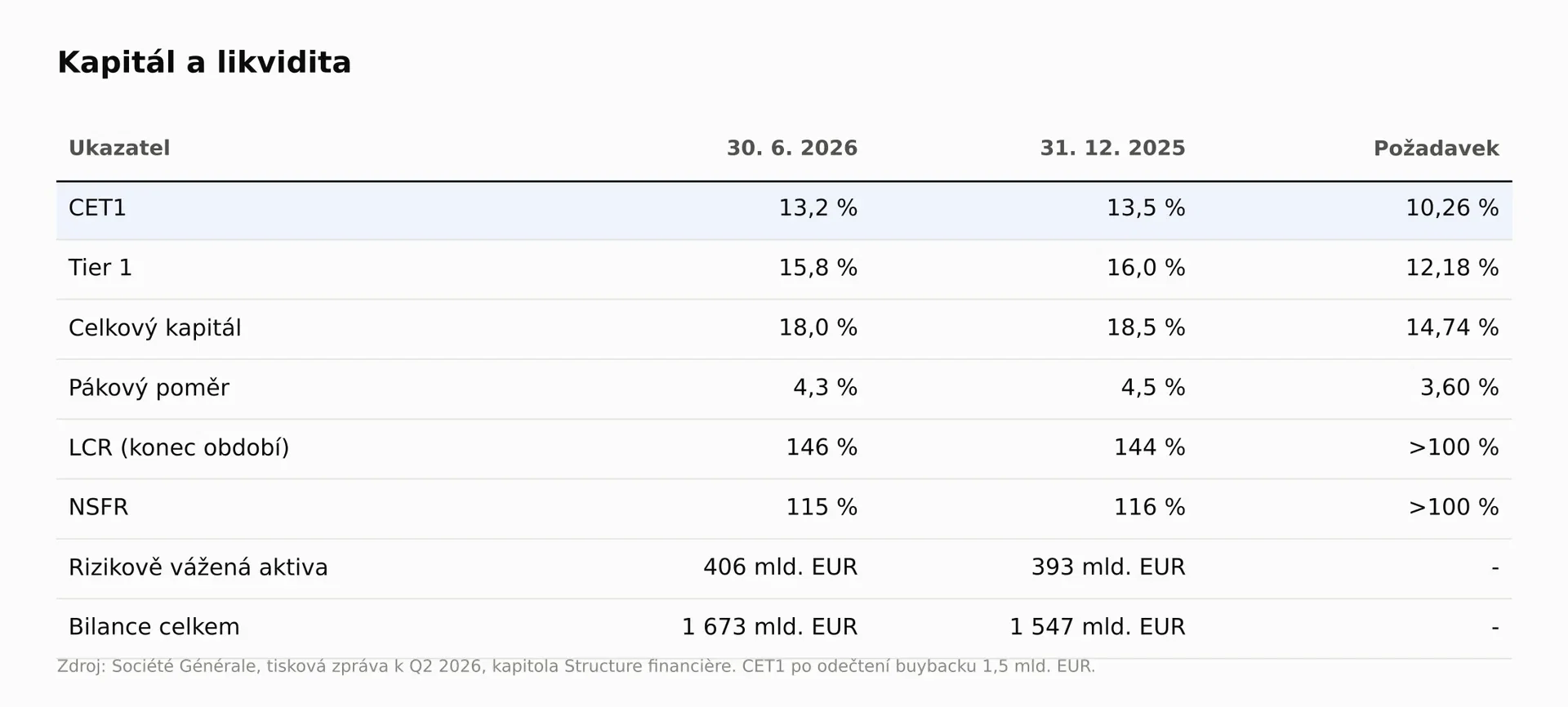
Liquidity is strong: LCR (the stock of liquid assets for a 30-day stress period) is 146%, and NSFR (funding stability over one year) is 115%; both requirements are 100%. Rating agencies moved mostly upward in 2026: Fitch raised its rating from A- to A+ in May, and S&P changed its outlook to positive in June. Moody’s maintains A1 with a negative outlook.
Share count and dilution: The average number of shares used to calculate EPS fell from 776 million in 2025 to 738 million in H1 2026 (-4.9%). The bank completed its extraordinary 1.5 billion EUR buyback on 1 October 2026, purchasing 19.87 million shares at an average of 75.5 EUR. On the other hand, the employee share program saw the bank issue new shares in July. According to the company, buybacks will fully offset its dilution. But as we saw on the stream, the company is actually reducing its number of shares in circulation.
The buyback at 75.5 EUR was practically at the level of tangible book value of 74.5 EUR per share, so it barely changed value per share. If the bank bought at today’s price, each buyback would increase value per share, because it would be buying one euro of capital for 87 cents.
Capital allocation under the Capital Markets Day plan: The bank will distribute 50% of adjusted profit, split equally between dividends and buybacks. That should amount to more than 13 billion EUR over 2026-2029, with dividends per share growing 10-15% annually. The bank wants to distribute any capital above CET1 of 13% on top of that, which would amount to another 8 billion EUR if it distributed everything. It decides on excess capital once a year, alongside Q2 results.
8. Capital efficiency: ROTE, RONE and cost of capital
ROTE and ROE are not the same. ROE was 10.6% in H1 2026, while ROTE was 12.0%. ROTE is calculated using only tangible capital, excluding goodwill and intangible assets, and shows the return on capital that would actually absorb losses in a crisis. That’s why banks and investors use it as their primary metric, and why the valuation in chapter 12 is based on it.
RONE is not ROTE. RONE is the return on capital allocated to a division according to the rule of 13% of its risk-weighted assets. The divisions have RONE of 14.2%, 19.1% and 13.5%, but the group’s is only 12.0%. The difference comes from headquarters: in H1 2026, it lost 177 million EUR while tying up 12.6 billion EUR in capital. If headquarters broke even, the group’s ROTE for H1 2026 would be 12.6% (my calculation).
For a bank to create value, its ROTE must exceed its cost of equity (COE), the return shareholders require from it. For European banks, this is usually estimated at 10-12%. For SG, I use 11% and 12.5%, because the difference between them is precisely the risk premium for France.
With ROTE of 12%, the bank is currently earning roughly its cost of capital, not more. So a fair valuation is around one times tangible book value, not significantly above it. SG will have to earn a premium valuation by delivering 13-14% in 2029.
9. Macro: France, bonds and interest rates - The most important part of the analysis!
The main controversy around SG today isn’t the bank, but France. Since the beginning of the energy crisis around the Strait of Hormuz, the 10-year OAT yield has risen by 150 basis points. On 6 October 2026, it reached 4.92%, its highest level since July 2002, and the spread over the German Bund reached 152 basis points, its widest since 2011. Sébastien Lecornu’s government submitted a 2027 budget targeting a deficit of 5.0% of GDP, down from 5.4% in 2026, with 54 billion EUR in savings. The National Assembly will vote on it on 20 and 27 October, and France has presidential elections in spring 2027.
This affects the bank through four channels. First, funding: as France’s risk premium rises, French bank bonds become more expensive too. Second, taxes: the 2027 budget extends the extraordinary surcharge on large companies’ income tax, but reduces its proceeds by about a third. The risk is that parliament raises it again during debate. Third, sovereign bonds held: according to French regulator ACPR, French banks hold 190 billion EUR in domestic sovereign debt, or 2% of their assets. I haven’t verified the exact figure for SG in the latest EBA data, so I’m not including it. Fourth, the economy: in June, Banque de France cut its 2026 growth forecast to 0.5%, and a weaker economy means higher loan losses. Higher interest rates on their own are more likely to help retail, because the bank gradually reinvests deposits in higher-yielding assets. The problem isn’t the level of interest rates, but France’s risk premium: it makes funding more expensive without bringing the bank a higher margin.
The market is selling SG as the most liquid way to bet against France. In my view, three of the four channels are manageable and already partly priced in. The truly dangerous scenario is an uncontrolled one: the government falls, the budget contains no savings, and France is downgraded, pushing the spread above 200 basis points.
10. Credit quality and stress test
Cost of risk was 0.26% of loans on an annualized basis in H1 2026 and 0.27% in Q2 2026, within management’s outlook of 25-30. The share of non-performing loans fell from 2.81% at the end of 2025 to 2.70% as of 30 June 2026, and 83% of them are covered by provisions, guarantees and collateral. The bank is holding provisions for performing loans steady at 2.93 billion EUR.
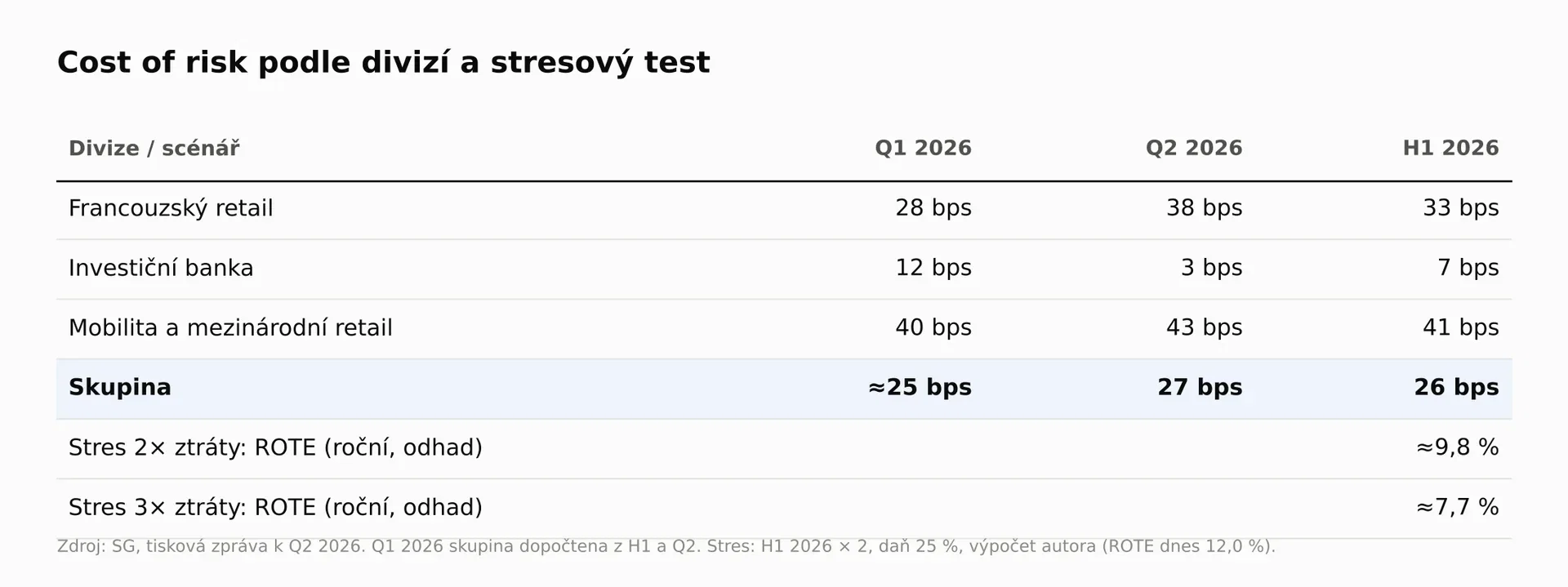
But things are shifting beneath the surface. In French retail, cost of risk rose from 28 basis points in Q1 2026 to 38 in Q2 2026, and in the international division it rose from 40 to 43. The group’s figure is kept low by investment banking, at just 3 basis points in Q2 2026. That level can’t last long.
Stress test: On the stream, we said that doubling losses would be a good test. Doubling H1 2026 gives annual loan losses of 1.49 billion EUR. Doubling them would reduce profit by 1.12 billion EUR after tax (I’m assuming 25%), or 16% of net profit, and ROTE would fall from 12.0% to 9.8%. Tripling them would reduce profit by 2.24 billion EUR and ROTE would fall to 7.7%. The bank would remain profitable in both cases, and CET1 would not fall below the requirement. This is my simplified estimate, without any impact on revenue.
Credit quality isn’t a problem today, and the bank has a buffer for a significantly worse year. But I’d watch French retail closely, where losses are rising just as the economy is slowing.
11. Controversies and risks
11.1 French retail is growing only on margins
What critics say: French retail net interest income rose 14.9% in Q2 2026, but SG network deposits fell 3% year over year to 219 billion EUR and loans fell 2% to 190 billion EUR. In 2025, net interest income would have grown by just 3.1% without the effect of expiring hedges. Once that effect runs out, the division will stop growing and group ROTE will fall.
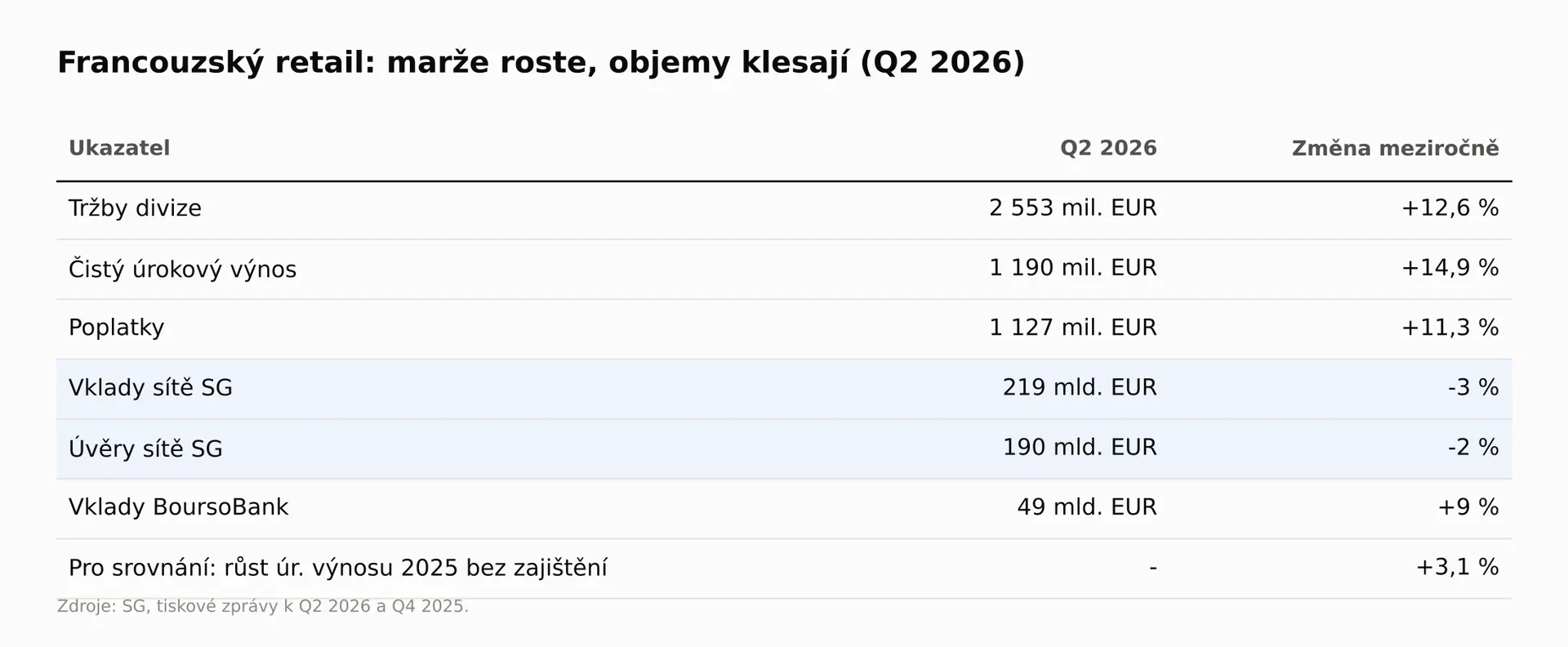
What the company says in response: Current account deposits are growing, and only term deposits are declining; clients are moving money into savings and investments managed by the bank. The division’s fees rose 11.3% in Q2 2026, private bank assets rose 10%, and life insurance rose 11%. In addition, from 1 October 2026, the head of BoursoBank is also managing SG network clients, so the bank wants to shift clients to a cheaper digital model, not lose them.
What this means for investors: Critics are right that volumes don’t show business strength. The company is right that some of the “lost” deposits remain in the group as fee-generating assets. The balance between these two trends will decide the outcome. I’d track net interest income, fees and volumes side by side each quarter.
11.2 Weak bond and currency trading
Three perspectives: Critics point out that FICC (currency trading) has fallen for three consecutive quarters, down 15.0% in H1 2026, and say SG is underinvested in this business. The company responds that its portfolio is concentrated in Europe and interest rates, where conditions are unfavorable, and that its plan through 2029 doesn’t rely on investment banking revenue growth; investments are going into prime brokerage and recurring revenue. For investors, the takeaway is that weak FICC is a real weakness, but the plan doesn’t depend on it. For the thesis, it’s more a missed opportunity than a risk.
11.3 Credibility of the plan through 2029
What critics say: SG has moved its targets in the past, and after the plan was announced in September 2023, the shares fell by a double-digit percentage in a single day. The plan through 2029 relies mainly on cuts: gross savings of 1.9 billion EUR, a cost base below 16.3 billion EUR and revenue growth of only 3% annually.
What the company says in response: It exceeded all its 2025 targets, raised its 2026 targets twice and quantified its AI savings: potential of 500-600 million EUR, of which 350 million EUR is already included in the plan through 2029. The strategic partnership with Anthropic to deploy the Claude model across the bank should also help. For investors, this means that under Krupa, management has so far delivered a good track record on promises. But savings are the easier part of the plan. The harder part is sustaining revenue if French retail loses the tailwind from net interest margin.
11.4 Ayvens and warning signs
Ayvens: Q2 2026 revenue fell by 13% as profit from used-car sales normalized. The company says 330 EUR per vehicle is within its outlook of 200-600 EUR and leasing margins are growing. The risk is cyclical: in a recession, used cars will get cheaper and profit could fall below the outlook.
Warning signs: I described the recurring “one-off” employee share expense in chapter 6. CFO Leopoldo Alvear has been presenting results from 2025 to today, so I don’t see a change in that position.
12. Valuation
This is the first time I’m seriously discussing price, just as on the stream: business first, price second, so we don’t anchor ourselves. I don’t use EV/EBITDA or a free-cash-flow DCF for a bank, because debt is a raw material for a bank, not a source of financing, and a bank’s cash flow says nothing about its value. I use three methods: P/TBV with reverse valuation, P/E and distribution yield.
12.1 P/TBV and what today’s price implies
Tangible book value per share was 74.5 EUR as of 30 June 2026. At a price of 64.47 EUR as of 16 October 2026, P/TBV is 0.87. After the buyback is completed and the 0.75 EUR October dividend interim payment is made, I estimate book value per share at 73.7 EUR, leaving P/TBV practically unchanged. New figures are due on 29 October. A bank’s fair P/TBV can be derived from the formula (ROTE - g) / (COE - g), where g is long-term growth. Reversing the equation and plugging in today’s P/TBV and 2% growth gives a sustainable ROTE of 9.8% at a COE of 11%, and 11.1% at a COE of 12.5%, implied by today’s price.
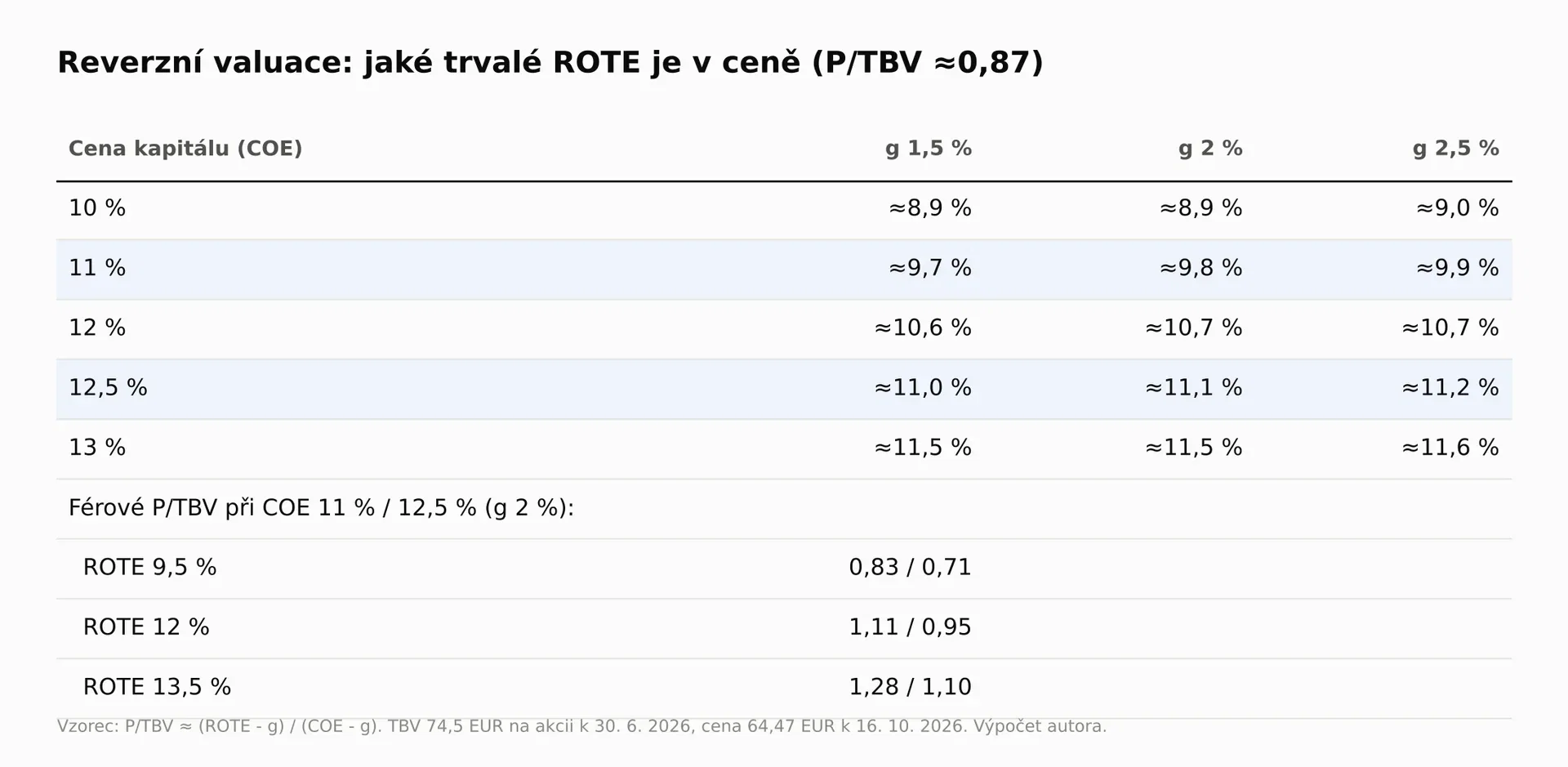
At the higher cost of capital, the market is pricing in exactly the 2026 target (ROTE of 11%) and nothing from the plan through 2029. At the lower cost of capital, it’s pricing in even less than the bank earns today. If SG delivered 13.5%, fair P/TBV would be 1.1 to 1.3, depending on the cost of capital. The conclusion therefore turns on a single assumption: how much premium for France the market will demand over the long term.
12.2 P/E
Analyst consensus before Capital Markets Day forecast net profit of 6.3 billion EUR for 2026 and 6.8 billion EUR for 2027. After deducting interest on hybrid bonds (0.76 billion EUR annually) and dividing by the number of shares, that implies EPS of 7.6 EUR for 2026 and 8.5 EUR for 2027 (my calculation). At today’s price, that means P/E ratios of 8.5 and 7.6. A simplified calculation doubling H1 2026 EPS (8.42 EUR) gives a P/E of 7.7. That’s a low multiple even for a European bank, and reflects the discount for France.
12.3 Distribution yield
In H1 2026, the bank accrued 2.19 EUR per share for distribution (50% of profit). That comes to 4.4 EUR for the full year, or 6.8% at today’s price, split equally between dividends and buybacks. The plan through 2029 promises more than 13 billion EUR in regular distributions, or 3.3 billion EUR annually, which is 7% of the 46 billion EUR market capitalization. If the bank distributed all its excess capital as well, the total would be 21 billion EUR, or 11% of market capitalization annually.
What today’s price implies: All three methods say the same thing. The market values SG as a bank that will sustain ROTE of around 10-11%, and assigns no value to the plan through 2029. Yet at today’s price, shareholders receive 7% annually in distributions, even if the valuation doesn’t change.
13. Scenarios
For each scenario, I estimate ROTE, tangible book value per share at the end of 2028 (today’s 73.7 EUR plus the retained half of profit) and the P/TBV the market would pay. The share price is then calculated as book value per share multiplied by P/TBV and compared with today’s price of 64.47 EUR.
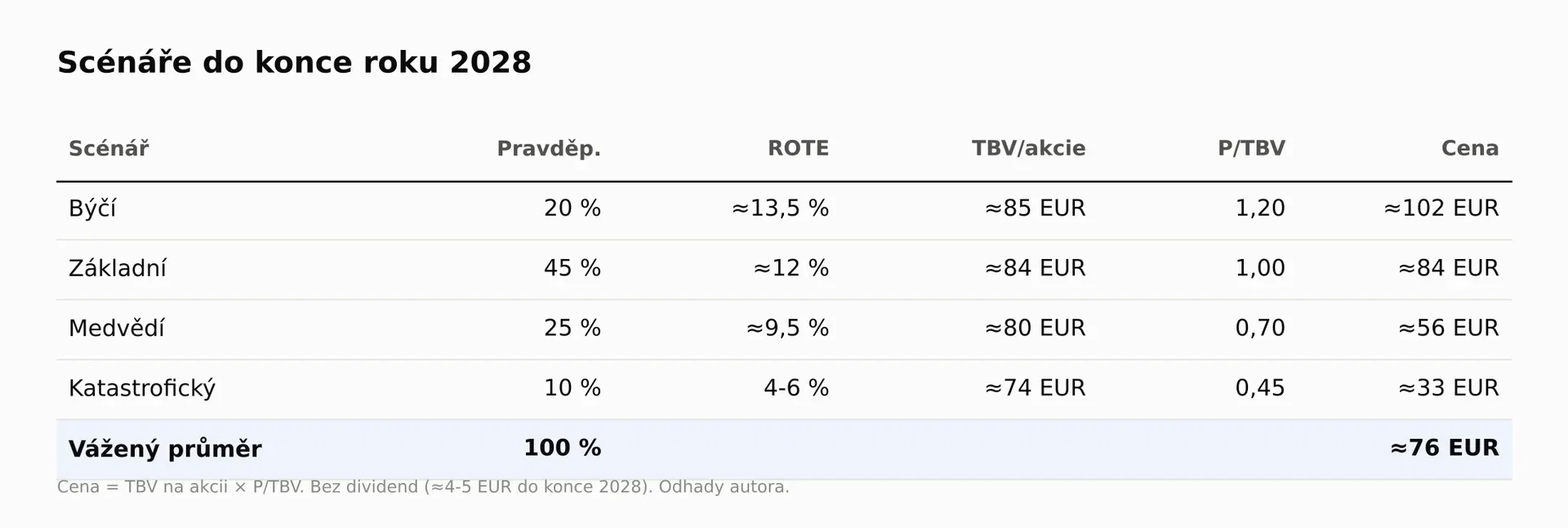
Bull case (20%): The plan through 2029 is on track, ROTE is heading toward 13.5%, and France’s spread settles after the budget is passed. Book value per share is 85 EUR, the market pays 1.2 times, and the share price is 102 EUR, or +58% versus today’s price.
Base case (45%): ROTE holds around 12%, France muddles through without a crisis, and the cost of capital remains elevated. Book value per share is 84 EUR, P/TBV is 1.0, and the share price is 84 EUR, or +30%.
Bear case (25%): Retail net interest income runs out, the tax surcharge rises, and loan losses approach 40 basis points. ROTE is 9.5%, book value per share is 80 EUR, P/TBV is 0.7, and the share price is 56 EUR, or -13%.
Catastrophic case (10%): A French debt crisis pushes the spread above 200 basis points, bond losses mount and distributions are restricted. ROTE is around 4-6%, book value per share is 74 EUR, P/TBV is 0.45, and the share price is 33 EUR, or -49%.
Weighted average: 0.20 × 10² + 0.45 × 84 + 0.25 × 56 + 0.10 × 33 = 75.5 EUR, rounded to 76 EUR, or 17% above today’s price of 64.47 EUR. In addition, shareholders would receive 4-5 EUR in dividends by the end of 2028, or another 6-8% of today’s price, if distributions are maintained. That would put the total expected return at roughly 24-25%.
14. Catalysts and what to watch
The next three weeks will matter more for sentiment than the entire quarter. The National Assembly votes on the budget on 20 and 27 October 2026, and analysts expect the government to push it through without a vote under Article 49.3. Q3 2026 results are due on 29 October 2026, full-year results on 4 February 2027, and the bank will decide on any further excess capital alongside Q2 2027 results. France’s presidential election is in spring 2027. Each quarter, I’d watch three things.
1. French retail: Net interest income, fees, and SG network loan and deposit volumes side by side. The key is whether the decline in volumes stops before margin growth runs its course.
2. Loan losses and capital: Cost of risk by division, CET1 against the 13% target, and the leverage ratio against the 3.6% requirement.
3. Costs and France: Progress toward a cost base below 16.3 billion EUR in 2029 and the OAT-Bund spread. Below 100 basis points, the discount for France should narrow; above 150, the risk of the bear scenario increases.
15. Conclusion
What’s indisputable: Société Générale has undergone a genuine turnaround. Costs are falling, ROTE rose from 4.2% in 2023 to 12.0% in H1 2026, capital and liquidity are strong, and the bank is returning substantial amounts of money to shareholders. The four questions from the stream turned out to be data errors, not company problems.
What’s debatable: Whether French retail growth will survive the end of the interest margin effect while volumes are declining. And whether France can get through its budget and elections without a crisis that would raise funding costs and loan losses.
Where today’s price stands: At a P/TBV of 0.87, the market is pricing in ROTE of 10-11%, roughly the 2026 target, and nothing for the plan through 2029. Today’s price is between the bear case (56 EUR) and the base case (84 EUR), closer to the bear case. The weighted average of 76 EUR is 17% above it.
What would change my view: Positively, two consecutive quarters of stable volumes in French retail and an approved budget that calms the spread. Negatively, a government collapse, a downgrade of France, or group-wide cost of risk above 35 basis points.
Answer to the main question: The market is mainly punishing France today, not Société Générale. But the bank hasn’t yet earned the right to be viewed separately from France, and until it does, the discount will remain.
16. My personal view
Up to this point, I’ve stuck to the numbers. Every claim in the analysis has a source or calculation you can verify for yourself, and I’ve tried to give equal weight to what supports Société Générale and what argues against it. This chapter is different. It’s no longer about what the data says, but what I would do with it if I were deciding what to do with my own money today. So take this as my opinion, not as the conclusion of the analysis.
I don’t currently own Société Générale shares, but it’s on my watchlist, and the longer I follow it, the more interested I become. I like that I’m not buying a story I have to imagine for myself. The turnaround has already happened, and it’s visible in the numbers: costs are falling, ROTE has tripled in three years, and the bank is returning roughly 7% of its market value to shareholders annually. And for all of this, the market is currently paying less than the bank’s tangible capital is worth.
But a cheap stock isn’t necessarily a good buy. A bank in a country with a knife-edge budget and a presidential election ahead could get even cheaper. And what worries me more than France itself is French retail: both loans and deposits are falling, and growth is being sustained only by net interest margin. If that doesn’t turn around in the coming quarters, the plan through 2029 will rely mainly on cuts, which is thin ice for a multi-year bet.
At what price I’d buy: I consider today’s price of 64.47 EUR fair, not attractive. The budget vote and Q3 results are both coming before the end of October, and I don’t want to pay full price when the two nearest events could move the shares by tens of percent in either direction. So I’d make my first purchase only around 57 EUR, roughly 12% below today’s price. At that price, the shares would trade at 0.77 times tangible book value, practically at my bear-case level (56 EUR), the weighted average of the scenarios would be a third higher, and distributions to shareholders alone would amount to around 7.7% annually. That’s the margin of safety I want with a French bank.
When I’d add and when I’d wait: If Q3 results show that the decline in French retail volumes has stopped and the budget passes without drama, I’d be willing to add at a higher price too, because the biggest uncertainty in the entire thesis would be gone. On the other hand, a government collapse, a downgrade of France, or cost of risk in French retail above 40 basis points would be a signal for me to wait, even if the shares fell below 57 EUR. A cheaper stock with worse fundamentals isn’t a better buy.
Position size: More likely small. I’d be buying not just a bank that has turned itself around, but also a piece of France, and I can’t assess that risk as well as I can assess the bank’s figures. My time horizon is through the end of 2028, as in the scenarios.