


A Slightly Spoiled Soup. Why Did the Famous Company Have to Cut Its Dividend After a 67% Plunge?

Campbell's stock is near its lows after a year of declines, and screeners show a 6.8% yield. But in September, management cut the dividend for the first time since 2001, even though it had the cash to pay it. What will be left of that figure for someone buying today?
Key points
Screeners show a 6.8% yield for Campbell's, but the new quarterly payout tells a completely different story.
The company cut its dividend for the first time since 2001, even though operating cash flow was more than enough to cover it.
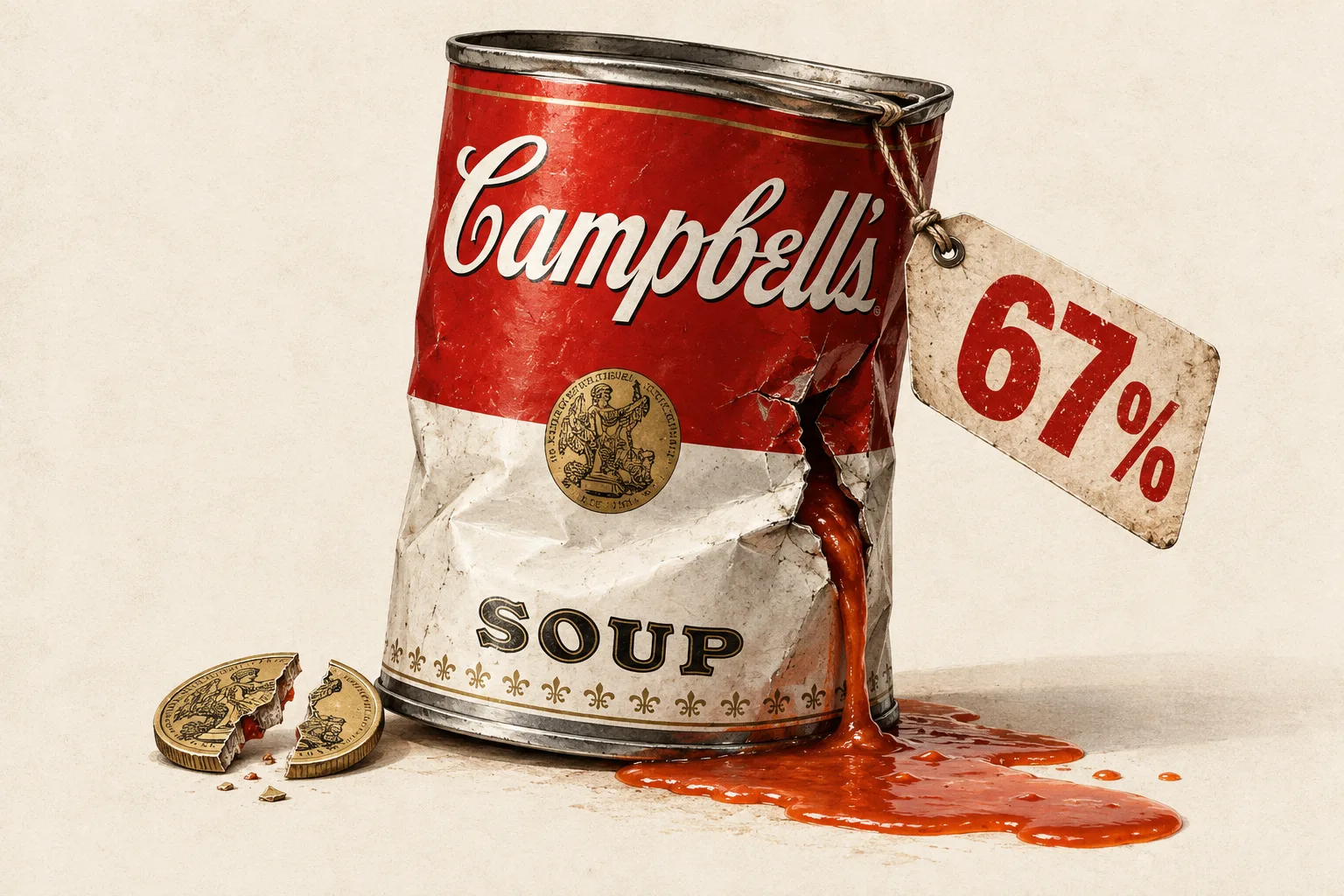
The stock is down 67% from its December 2022 peak, and 11 of 29 analysts recommend selling.
Two contradictory businesses operate within a single company—one is growing, while the other is plunging by double-digit percentages.
Bulios's fair value is 47% above the market price; a single balance-sheet item accounts for the difference between the two views.
A number in the rearview mirror
Dividend screeners currently show Campbell's $CPB with a 6.8% yield. In the packaged-food sector, where payouts are typically 3 to 4 percent, that looks like a gift. But that figure doesn't tell you what you'll get. It tells you what the company paid over the past twelve months: three quarterly dividends of 0.39 USD and one new payment of 0.25 USD, for a total of 1.42 USD per share. Divide that by the 21 USD share price, which the stock fell to after losing 30.7% over the year, and you get 6.8%.
The new reality is different. Since September, the company has been paying 0.25 USD per quarter, or 1.00 USD a year. Anyone buying today will get 4.8%. And the trailing yield shown by screeners will mechanically decline each quarter, even if the share price doesn't move a cent: with each new payment, one old 0.39 USD payment drops out of the twelve-month total and is replaced by 0.25 USD.
It's like an apartment listing where the landlord has already told the tenant that the rent is going down, but the old amount is still posted in the ad. Anyone who reads only the listing counts on money that will never arrive. But understanding why this happened is more important than the number itself—because that's what determines whether 4.8% is a dividend the company can earn or just another number on the way down.