


This Influencer Favorite Stock Fell 41% in a Month. Is It an Opportunity?

Nebius shares have lost nearly half their value over the past month. After a sharp rally, the question hanging over the stock is whether the decline has finally created a more attractive entry point into specialized AI infrastructure, or whether it is simply beginning to price in more realistically the extreme capital expenditures, need for additional financing, and uncertainty over whether massive investments in GPUs and data centers will deliver commensurate returns for shareholders.
Key points
The decline is largely sector-wide. It was driven by financing concerns, high yields on CoreWeave bonds, Microsoft’s lower-than-expected capex, and Gartner’s warning about the survival of most neoclouds.
Q2 2026 fundamentals remain strong: revenue of 582,3 million USD (+454 % year over year), adjusted EBITDA of 236,2 million USD (41 % margin), and ARR of 3 billion USD. Q3 2026 results are due on November 12, 2026.
The 2026 capex plan of 20-25 billion USD is extreme. The company spent 8,1 billion USD in the first half of the year. Revenue growth alone does not create value unless the return on capital proves attractive.
A backlog of over 40 billion USD and prepayments covering 50-60 % of capex on some contracts reduce near-term financing needs, but they do not guarantee execution or protect against falling GPU prices.
Revenue growth alone does not guarantee shareholder value. With capex of 20–25 billion USD and high GPU depreciation, returns on invested capital may remain low.
Company overview
Nebius Group was formed in 2024 as the successor to Dutch holding company Yandex N.V. after the sale of its Russian assets. The company specializes in AI cloud services and infrastructure for artificial intelligence computing. It offers GPU-as-a-service and a full-stack platform optimized for model training and inference. Unlike hyperscalers, it does not have a broad ecosystem of software and services. It competes primarily with specialized neoclouds such as CoreWeave $CRWV, while also renting capacity to large technology companies.
The AI compute market is growing rapidly, driven by demand for large-model training and the increasingly widespread use of inference in production. At the same time, it is exceptionally capital-intensive. Data centers, GPUs (especially NVIDIA $NVDA), energy infrastructure, and grid connections require billions of dollars before they begin generating stable cash flows. Hardware depreciation is high, the economic life of GPUs shortens with each new generation, and capacity utilization must be high for investments to pay off.
Changing investor sentiment and the broader context behind the decline
Investor sentiment toward this segment deteriorated in October and November 2026. CoreWeave bond yields $CRWV rose to around 15 % and above, Microsoft $MSFT announced lower-than-expected capital expenditures (partly due to third-party delivery delays), and reports emerged of temporarily tighter access to debt markets for companies without strong independent revenue streams. CEO Arkady Volozh himself mentioned that some sources of capital had temporarily closed. This explains much of the decline without any fundamental change to Nebius’s announced contracts or outlook.
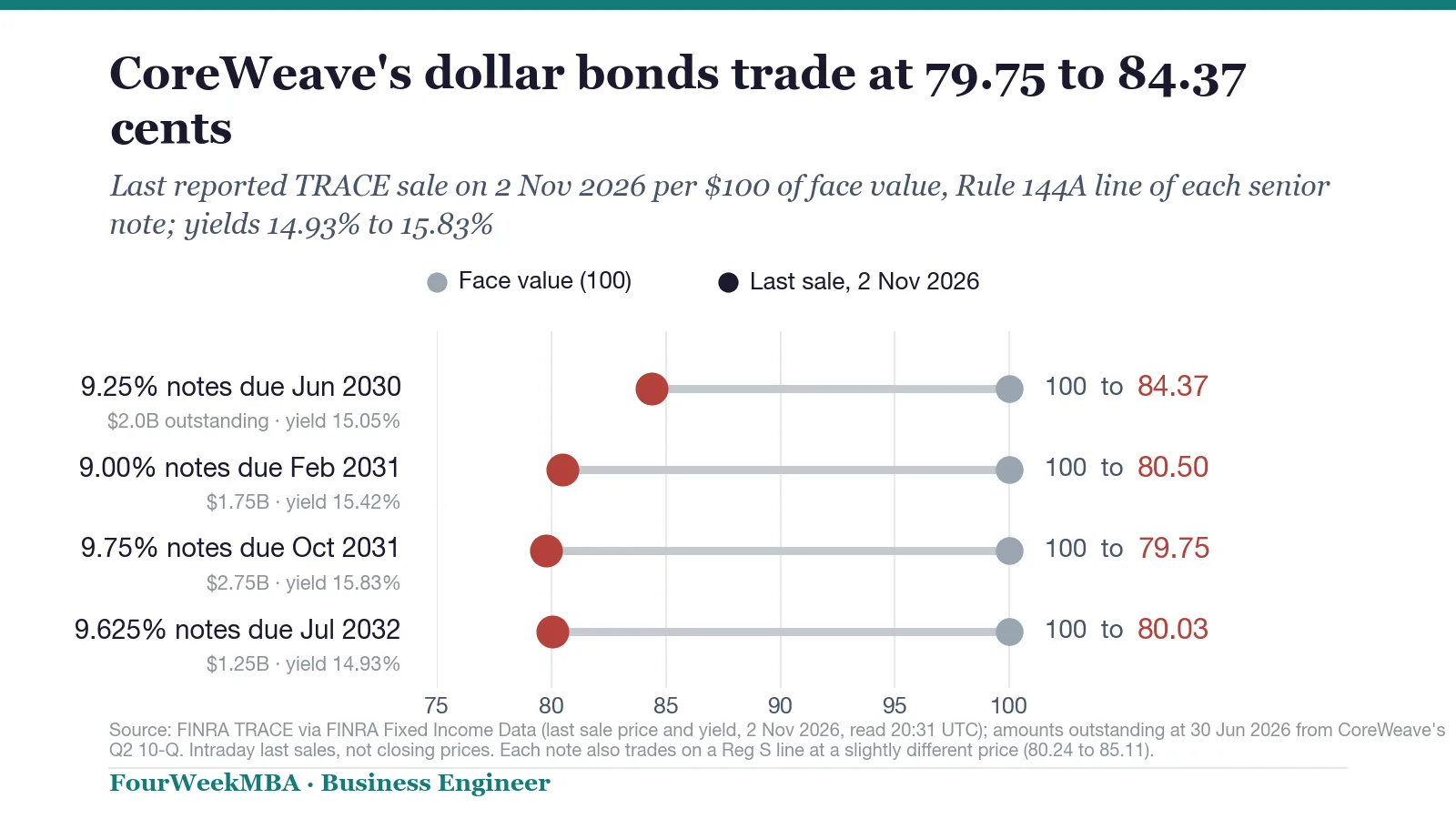
CoreWeave bond yields reach 15-16 %
A broader sell-off in technology stocks and profit-taking after the previous sharp rally amplified the move. Changing sentiment toward AI infrastructure has thus become the dominant factor, while specific company fundamentals have remained largely unchanged. Investors are now taking greater account of the fact that growth in demand for computing power alone does not guarantee attractive returns for every provider. The risk of oversupply, technological obsolescence, and rising financing costs has become part of valuations.
The company’s history adds another layer. Its origins in the restructuring of Yandex brought an experienced technical team and existing infrastructure outside Russia, but also the need to quickly rebuild its business model around pure-play AI infrastructure. This created an opportunity, but also means the company does not have decades of cloud ecosystem development behind it like the hyperscalers. Investors therefore need to distinguish between short-term revenue growth from deploying new capacity and the long-term ability to generate sustainable cash flows after depreciation and the cost of capital.
The broader macroeconomic environment in the second half of 2026 also played a role. Higher interest rates increase the cost of debt financing, which is crucial for a capital-intensive business. There have also been signs that not all large technology companies are increasing AI infrastructure capex at the pace the market expected just a few months ago.
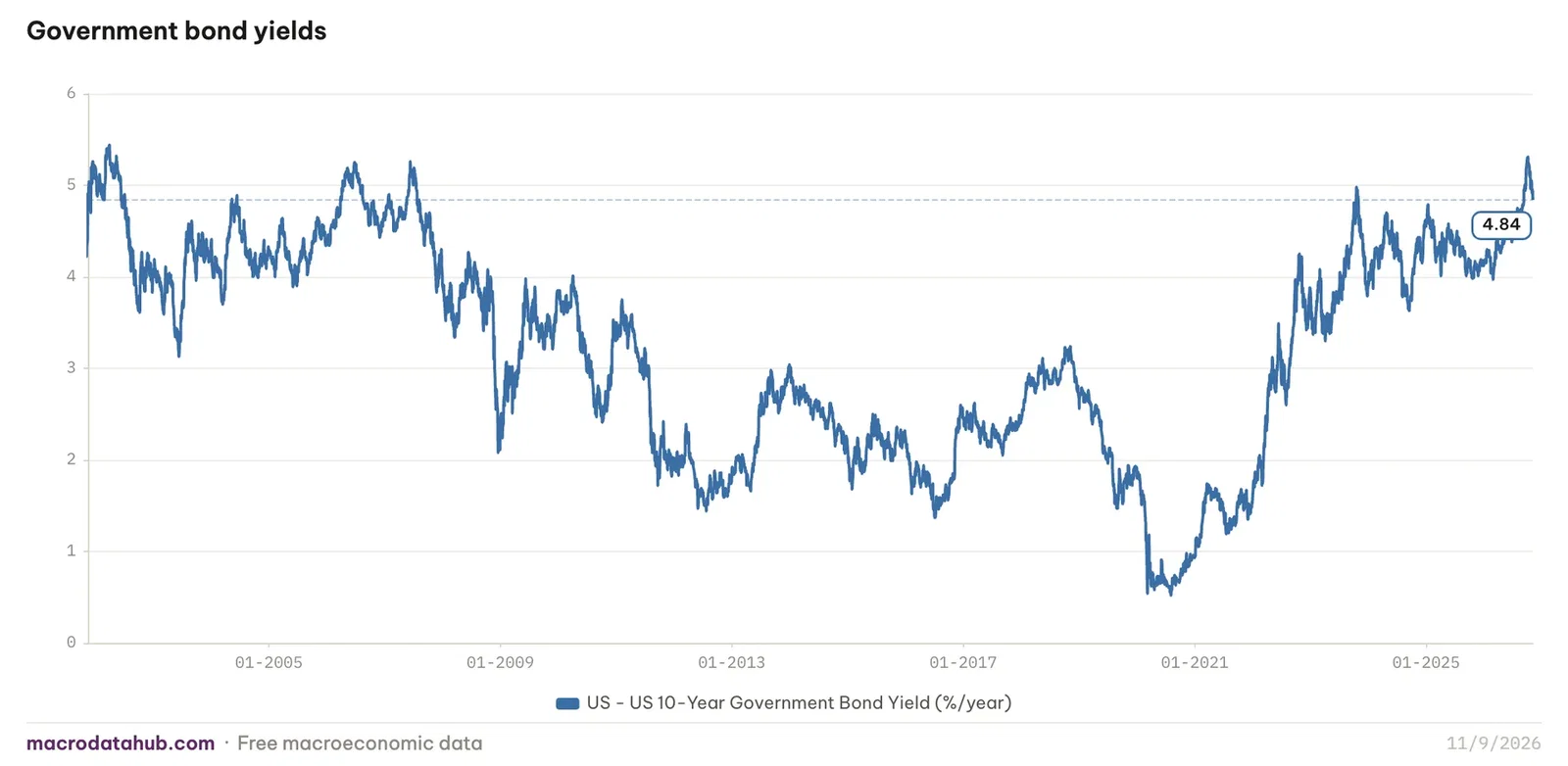
U.S. 10-year Treasury yield
This does not mean demand is ending, but a slower pace could affect how quickly new capacity pays for itself. This environment is more challenging for specialized providers like Nebius than for hyperscalers, which can finance expansion with cash flows from other business segments. Gartner and other industry analysts have warned that most neoclouds may not survive in the long term amid growing competition and high capital requirements. This context explains why the decline hit a broader group of specialized AI capacity providers.
Nebius Group
Business model and segments
Nebius addresses the shortage of specialized computing capacity for AI. It primarily sells enterprise customers and AI labs access to GPU clusters (NVIDIA Blackwell and later generations), storage, networking, and a software layer that makes it easy to deploy models. Its model is both usage-based and contract-based. Large contracts (Microsoft, Meta, and others) have an average value of over a billion dollars and often include prepayments covering a significant portion of capex.
AI cloud accounts for the vast majority of revenue (approximately 575 million out of 582,3 million USD in Q2 2026, or 98 percent). The group’s other activities are smaller: Avride (autonomous vehicles and robots), TripleTen (edtech and IT retraining), and equity stakes in ClickHouse (approximately 28 percent) and Toloka (AI data). These businesses contribute to the group’s overall value, but AI infrastructure is decisive for its current valuation. Valuing Nebius purely as an AI cloud company is roughly right, but investors should keep in mind the potential for future monetization of its stakes.
History, leadership, and company control
Nebius’s Yandex history brings an experienced team (Volozh is Yandex’s founder and current CEO) and technical expertise, but also a distinctive control structure. Volozh holds substantial voting rights through Class B shares. This gives management stability but limits the influence of other shareholders. The company is headquartered in Amsterdam and operates data centers in Europe and the U.S. (including projects in New Jersey and Alabama).

CEO Arkady Volozh
The business model differs from traditional cloud providers in its narrow focus on AI workloads and its greater flexibility in deploying the latest hardware. At the same time, it lacks the broad software platform and distribution reach of hyperscalers. It wins customers through a combination of direct sales to large technology companies and offerings for AI-native businesses. GPU rentals, ownership or long-term access to data centers, securing energy capacity, and long-term contracts form the core of the business.
The company is also experimenting with asset-light models, in which partners own the infrastructure while Nebius provides software and customers. This approach can reduce capital intensity in some regions, but it also means some of the margin goes to partners and Nebius has less control over physical infrastructure. Distinguishing between the AI cloud and other activities is crucial for valuation. Avride and TripleTen are currently loss-making and require investments that reduce the group’s margin. Stakes in ClickHouse and Toloka represent potential sources of value if monetized in the future, but currently do not contribute significantly to revenue.